
When you buy something, you usually receive a receipt.
But not all receipts are the same.
Some receipts show every product and service separately. Others only display the total amount paid.
This is where many people get confused about the difference between an itemized receipt and a regular receipt.
In this guide, you will learn:
- What an itemized receipt is
- What a regular receipt is
- Key differences between them
- When each type is used
- Why businesses prefer itemized receipts
- FAQs about itemized and non-itemized receipts
If you run a business, manage expenses, or create receipts online, this guide will help you understand everything clearly.
What is an Itemized Receipt?
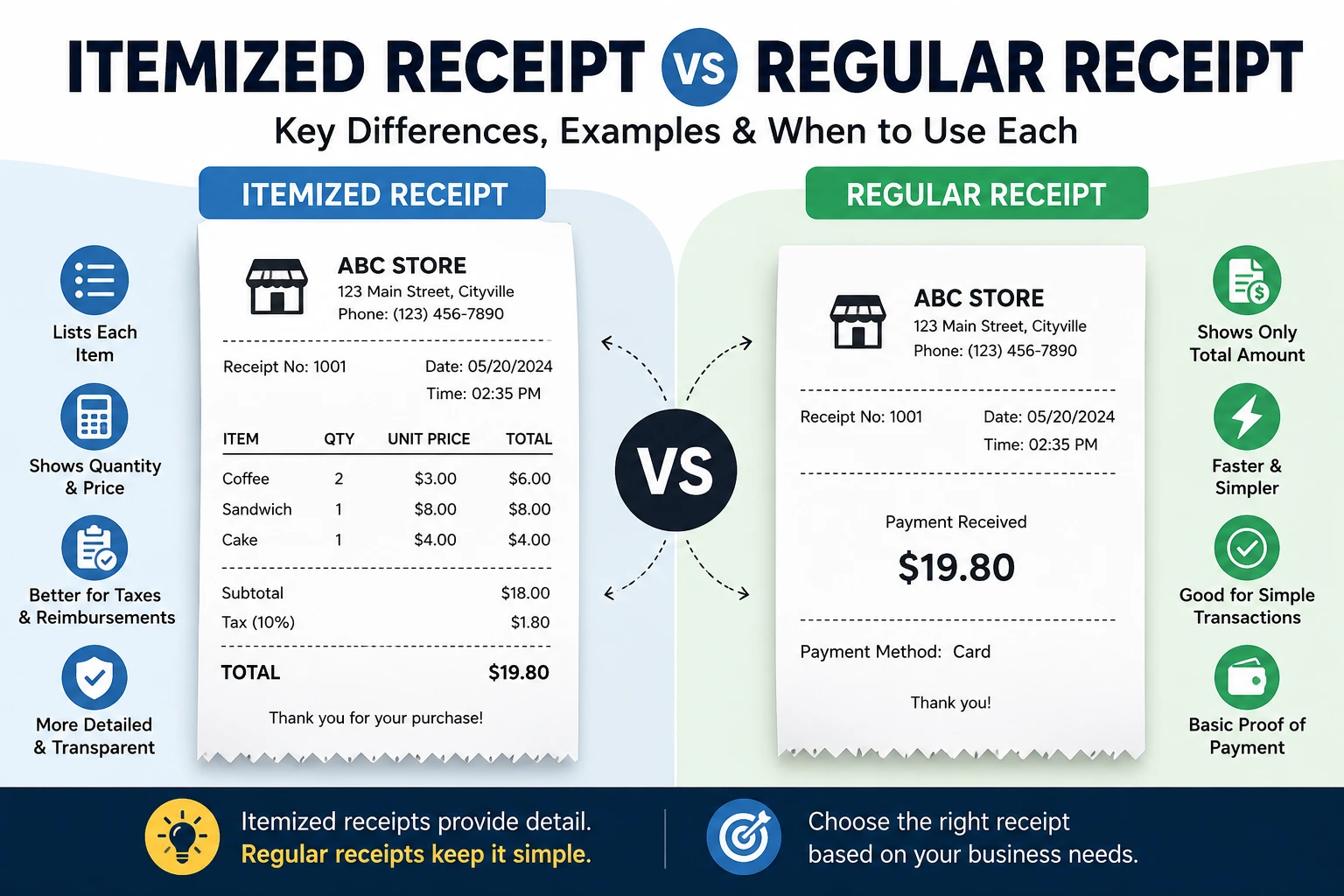
An itemized receipt is a receipt that lists every item or service separately.
It shows detailed information about the purchase.
A typical itemized receipt includes:
- Product names
- Quantity
- Individual prices
- Taxes
- Discounts
- Total amount
For example:
| Item | Qty | Price |
|---|---|---|
| Coffee | 2 | $6 |
| Sandwich | 1 | $8 |
| Tax | $1 | |
| Total | $15 |
This type of receipt gives a complete breakdown of the transaction.
Businesses often use itemized receipts for:
- Expense tracking
- Tax reporting
- Business reimbursements
- Accounting records
- Customer transparency
What is a Regular Receipt?
A regular receipt is a basic proof of payment.
It usually contains limited information.
A regular receipt may include:
- Store name
- Date
- Total amount paid
- Payment method
Example:
| Description | Amount |
|---|---|
| Purchase | $15 |
Unlike an itemized receipt, it does not show each individual item purchased.
Many small businesses and quick transactions use regular receipts because they are simple and fast.
Also see: Non-Itemized Receipt Template
Itemized Receipt vs Regular Receipt
The main difference between an itemized receipt and a regular receipt is the level of detail.
Here is a quick comparison.
| Feature | Itemized Receipt | Regular Receipt |
|---|---|---|
| Lists individual items | Yes | No |
| Shows quantity | Yes | Usually No |
| Displays unit prices | Yes | No |
| Better for taxes | Yes | Limited |
| Useful for reimbursements | Yes | Often rejected |
| Simpler format | No | Yes |
| Best for record keeping | Excellent | Basic |
An itemized receipt gives a full breakdown.
A regular receipt only confirms payment.
Why Itemized Receipts Matter
Itemized receipts are important for both customers and businesses.
They improve transparency and reduce disputes.
Here are the main reasons businesses use them.
1. Better Expense Tracking
Companies need detailed receipts for bookkeeping.
An itemized receipt helps accountants know exactly what was purchased.
This is useful for:
- Office supplies
- Travel expenses
- Meals
- Equipment purchases
Without itemization, it becomes difficult to classify expenses correctly.
2. Easier Tax Filing
Tax authorities often require detailed proof of purchases.
An itemized receipt provides:
- Tax amounts
- Product categories
- Service descriptions
This makes tax deductions easier.
For example, businesses claiming VAT or sales tax credits usually need itemized receipts.
3. Reduced Fraud
Detailed receipts help prevent fraud.
A customer can verify:
- Correct pricing
- Correct quantity
- Discounts applied
Businesses can also avoid fake reimbursement claims.
4. Improved Customer Trust
Customers appreciate transparency.
When every item is listed clearly, buyers feel more confident.
This improves customer experience and reduces refund disputes.
When Are Regular Receipts Used?
Regular receipts are still useful in many situations.
They work well for:
- Small cash transactions
- Parking payments
- Simple service payments
- Fast retail checkouts
For example:
- Taxi payments
- Small food purchases
- Street vendors
- Quick service kiosks
In these cases, customers may only need proof of payment.
Industries That Commonly Use Itemized Receipts
Some industries rely heavily on itemized receipts.
Restaurants
Restaurant receipts usually show:
- Food items
- Drinks
- Taxes
- Tips
This helps customers review their orders.
Hotels
Hotels provide detailed billing for:
- Room charges
- Meals
- Laundry
- Extra services
Business travelers often need these receipts for reimbursement.
Medical Clinics
Medical receipts often include:
- Consultation fees
- Medication
- Lab tests
- Procedures
Insurance companies may require itemized medical receipts.
Auto Repair Shops
Mechanics use itemized receipts to show:
- Parts replaced
- Labor charges
- Service fees
This protects both the customer and the repair shop.
Benefits of Using Itemized Receipts for Businesses
Businesses gain several advantages from detailed receipts.
Better Financial Records
Detailed receipts make accounting easier.
Business owners can track:
- Inventory
- Sales trends
- Profit margins
Easier Audits
During audits, itemized receipts provide supporting evidence.
This reduces accounting issues.
Professional Appearance
Itemized receipts look more professional.
Customers see exactly what they paid for.
This builds credibility.
Which Receipt Type is Better?
It depends on the situation.
Choose Itemized Receipts When:
- You need expense reimbursement
- You want accurate accounting
- Taxes must be recorded
- Customers need detailed billing
- You sell multiple products
Choose Regular Receipts When:
- The transaction is very simple
- Speed matters more than details
- Customers only need payment proof
Most businesses today prefer itemized receipts because they provide more value.
How to Create an Itemized Receipt
Creating an itemized receipt is easier than ever.
Businesses can use:
- POS systems
- Receipt templates
- Online receipt generators
- Accounting software
A professional receipt should include:
- Business name
- Contact information
- Receipt number
- Date and time
- Item descriptions
- Taxes
- Payment method
- Total amount
Many online tools can generate these automatically.
FAQs
What is the difference between itemized and non itemized receipts?
An itemized receipt lists every purchased item separately, including quantity and price.
A non-itemized receipt only shows the total amount paid without product details.
Itemized receipts are better for accounting, taxes, and reimbursements.
What is the opposite of an itemized receipt?
The opposite of an itemized receipt is a non-itemized receipt or regular receipt.
It contains minimal transaction details and usually only confirms payment.
Are itemized receipts necessary for reimbursement?
Yes, many companies require itemized receipts before approving reimbursements.
This helps verify what was purchased.
Can I create itemized receipts online?
Yes. Receipt Generator Pro tools allow businesses to create professional itemized receipts instantly.
These tools often support PDF downloads and printing.
Why do restaurants use itemized receipts?
Restaurants use itemized receipts to show food orders, drinks, taxes, and tips clearly.
This improves transparency and reduces billing disputes.
Final Thoughts
Understanding the difference between an itemized receipt and a regular receipt is important for both businesses and customers.
An itemized receipt provides detailed transaction information.
A regular receipt only confirms payment.
In today’s business world, itemized receipts are more useful because they support:
- Accurate bookkeeping
- Tax reporting
- Expense tracking
- Customer transparency
Businesses that use professional itemized receipts often appear more trustworthy and organized.
Whether you run a restaurant, hotel, retail shop, or online business, using detailed receipts can improve your operations and customer experience.