
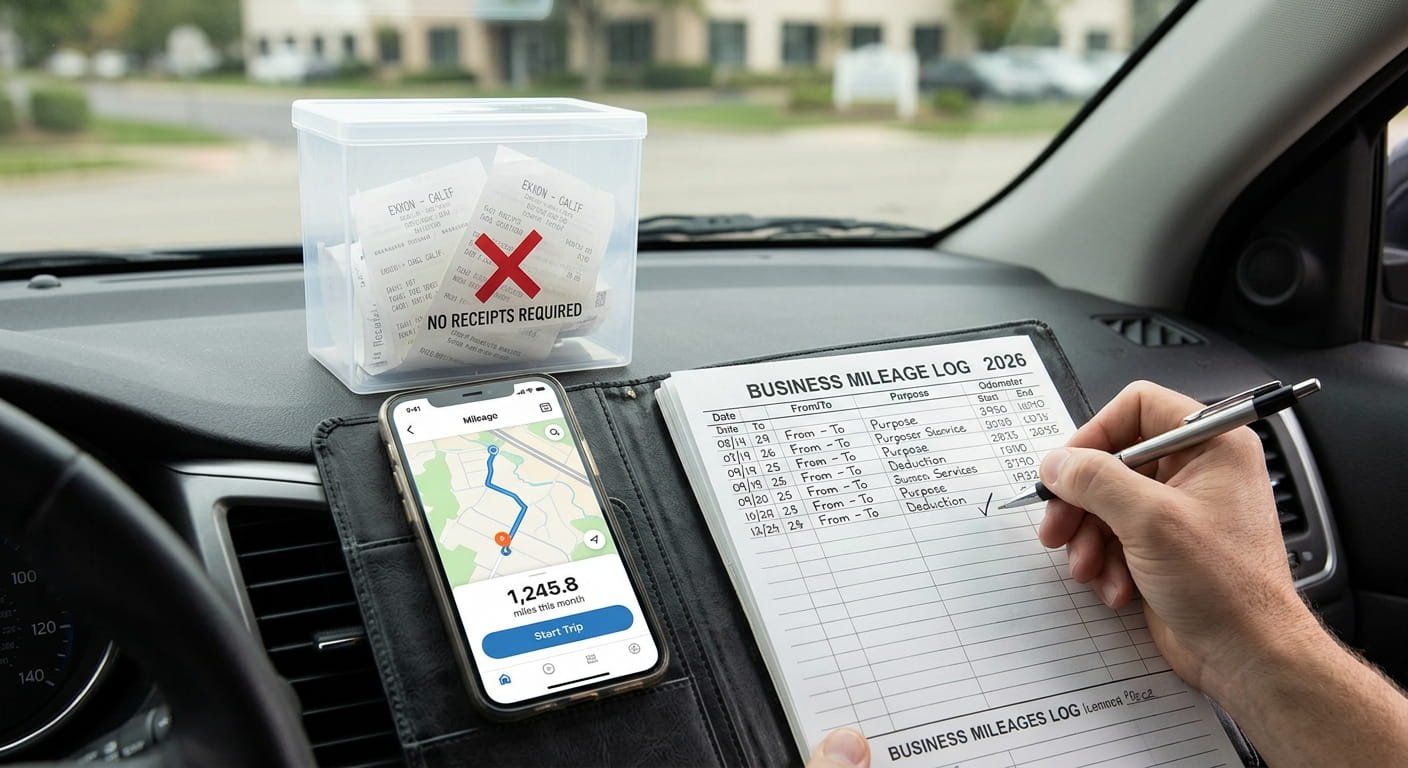
Yes — if you use the IRS Standard Mileage Rate, you do not need gas, maintenance, or repair receipts. However, you cannot deduct mileage without records. Instead of expense receipts, the IRS requires a contemporaneous mileage log proving your business trips.
Choosing Your Deduction Method: When Receipts Matter
The exact documentation rules depend on which of the two IRS calculation methods you choose for your vehicle:
1. Standard Mileage Rate (No Expense Receipts Needed)
When claiming the IRS standard rate—which for 2026 is 72.5¢ per business mile (Jan 1 – June 30) and 76¢ per mile (July 1 – Dec 31)—the flat rate already accounts for fuel, insurance, maintenance, and depreciation.
- What you skip: Gas station receipts, oil change invoices, tire receipts, and insurance bills.
- What you still need: A written or digital mileage log recorded at or near the time of each trip, plus receipts for any separate business tolls or parking fees you want to claim on top of the mileage rate.
2. Actual Expense Method (Receipts Required)
If you choose to deduct the actual percentage of your vehicle’s operating costs (gas, repairs, lease payments, depreciation) rather than the flat rate, receipts and bills are strictly required. Under IRS Publication 463, documentary evidence (like a receipt or itemized statement) is mandatory for any expense of $75 or more.
IRS Recordkeeping Rules for Mileage Logs
Because the IRS disallows rough estimates or year-end guesses during an audit, your log must be kept consistently throughout the year.
Required Details for Every Trip
Whether you use a GPS mileage app, a spreadsheet, or a physical notebook, your records must show:
- Odometer readings: Your vehicle’s reading at the start and end of the tax year.
- Date of each trip.
- Starting point and destination.
- Business purpose (e.g., “Client pitch with Acme Corp” or “Supply run to Staples”).
- Miles driven for the trip.
Who Qualifies to Claim the Deduction?
Under current federal tax law, self-employed individuals, 1099 contractors, and small business owners can claim this deduction on Schedule C. Standard W-2 employees generally cannot deduct unreimbursed work mileage on federal returns, with narrow exceptions for qualified performing artists, armed forces reservists, and fee-basis government officials.
Read: IRS Donation Receipt Requirements: The Complete Guide
Conclusion
You do not need a shoebox full of gas station receipts to write off business driving, provided you stick to the IRS Standard Mileage Rate. What you cannot skip is a detailed, contemporaneous mileage log showing when, where, and why you drove. Keeping a simple spreadsheet or automated tracking app running throughout the year gives you audit-ready proof without the hassle of saving every fuel receipt.