
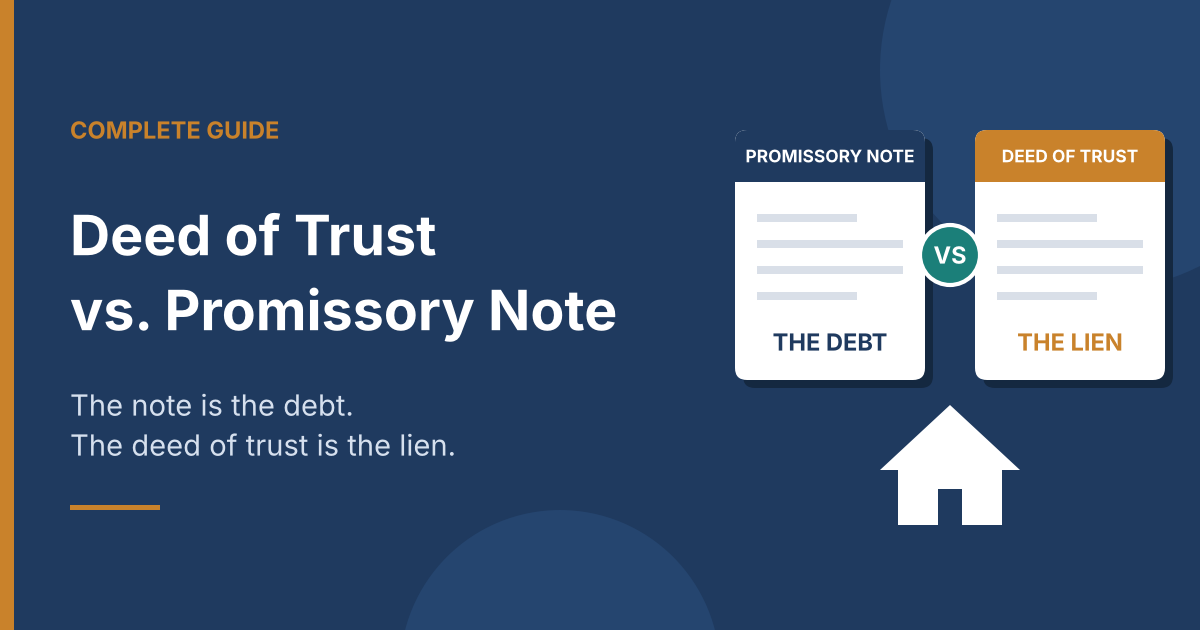
A deed of trust and a promissory note are two different legal documents used in real estate financing. A promissory note establishes the borrower’s legal promise to repay a loan, while a deed of trust secures that repayment by using real estate as collateral. Although they work together in a mortgage transaction, they serve different legal purposes.
The simplest way to understand the difference is that the promissory note documents the debt, while the deed of trust protects the lender’s interest in the property if the borrower fails to repay the debt.
When purchasing a home with financing in the United States, borrowers may be required to sign both documents at closing. Understanding what each document does, how they work together, and what happens when a borrower defaults can help property owners make informed financial decisions.
What Is a Deed of Trust?
A deed of trust is a legal document that secures a loan using real estate as collateral. It establishes a legal arrangement involving three parties: the borrower, the lender, and an independent third-party trustee.
The borrower, also called the trustor, uses the property as security for the loan. The lender, known as the beneficiary, receives the benefit of that security, while the trustee holds the legal interest or lien according to the applicable state’s law.
If the borrower fails to meet the loan obligations, the deed of trust may allow the trustee to initiate foreclosure and sell the property to recover the outstanding debt. The exact foreclosure procedure depends on state law and the provisions of the document.
For a legal definition, see Cornell Law School’s Legal Information Institute: Deed of Trust
Main Purposes of a Deed of Trust
- Secures the loan: Uses real estate as collateral to protect the lender.
- Identifies the parties: Establishes the borrower, lender, and trustee.
- Defines property-related obligations: Explains the borrower’s responsibilities for protecting the property and complying with loan conditions.
- Provides foreclosure rights: Establishes the legal framework for enforcing the security interest after default.
- Provides for release of the security: Allows the property interest or lien to be reconveyed or released after the loan is fully satisfied.
What Is a Promissory Note?
A promissory note is a written legal agreement in which a borrower promises to repay money borrowed from a lender under specified conditions.
In a real estate transaction, it documents the financial obligation between the borrower and the lender. It specifies how much money was borrowed, the interest rate, the repayment schedule, and other conditions governing the debt.
Unlike a deed of trust, a promissory note does not itself establish a security interest in the borrower’s property. Instead, it provides written evidence of the debt and the borrower’s obligation to repay it.
The Consumer Financial Protection Bureau explains the information typically found in a mortgage promissory note: What documents should I receive before closing on a mortgage loan?
Main Purposes of a Promissory Note
- Documents the debt: Establishes how much money the borrower owes.
- Creates a repayment obligation: Records the borrower’s promise to repay the loan.
- Specifies interest: Explains the interest rate and how interest applies.
- Establishes repayment terms: Identifies payment amounts, due dates, and loan duration.
- Explains default consequences: Describes what may happen if the borrower fails to make payments as agreed.
Deed of Trust vs. Promissory Note: Key Differences
The main difference between a deed of trust and a promissory note is their legal purpose. A promissory note establishes the debt, whereas a deed of trust secures that debt against real estate. Although both documents are commonly signed during the same real estate closing, they contain different information and create different legal rights.
| Comparison point | Deed of trust | Promissory note |
| Primary purpose | Secures the loan with real estate. | Records the borrower’s promise to repay. |
| What it represents | A security instrument. | Evidence of the debt and repayment obligation. |
| Parties | Generally borrower (trustor), lender (beneficiary), and trustee. | Generally borrower (maker) and lender/payee. |
| Property connection | Creates or documents the security interest in the property. | Does not by itself create a property lien. |
| Main contents | Property description, parties, secured obligations, covenants, default and enforcement provisions. | Principal, interest, payment schedule, maturity date, and default terms. |
| If borrower defaults | May permit foreclosure under applicable law and the instrument. | May allow the lender to pursue remedies to collect the debt. |
| After full repayment | The security interest is released or reconveyed as required by law. | The debt is satisfied; the note should be marked or treated as paid according to applicable procedures. |
| Typical signing | Signed by the property owner/borrower and acknowledged or recorded as required. | Signed by the borrower; generally retained by the loan holder. |
| Legal function | Protects the lender’s interest in collateral. | Establishes the borrower’s personal repayment obligation. |
How a Deed of Trust and Promissory Note Work Together
These documents are complementary. The promissory note establishes the borrower’s financial obligation, and the deed of trust gives the lender a security interest in the property to support that obligation.
1. The lender approves the loan
After reviewing the borrower’s application, income, credit, property, and other underwriting requirements, the lender agrees to provide financing. The parties settle the principal amount, interest rate, repayment period, and other terms.
2. The borrower signs the promissory note
The borrower signs the note to acknowledge the debt and promise repayment. The note sets out the payment terms and may address late charges, default, acceleration, and other remedies.
3. The borrower signs the deed of trust
The deed of trust identifies the property securing the loan and establishes the trustee’s role. It may contain covenants requiring the borrower to pay property taxes, maintain insurance, and avoid actions that could impair the lender’s security.
4. The deed of trust is recorded
Where required, the security instrument is recorded in the public land records in the county where the property is located. Recording provides public notice of the lender’s security interest and helps establish priority under state law.
5. The borrower repays the loan
The borrower makes payments under the promissory note and complies with the deed of trust. Once the debt is fully paid, the lender or beneficiary generally arranges for the lien or deed-of-trust interest to be released or reconveyed under the applicable state’s procedures.
Consequences under the promissory note
- The lender may demand overdue payments and applicable charges.
- The note may allow the lender to accelerate the debt, making the remaining balance due after specified conditions are met.
- The lender may pursue a lawsuit or other lawful debt-collection remedies, subject to applicable defenses and limits.
Consequences under the deed of trust
- The lender or beneficiary may instruct the trustee to begin foreclosure if the legal and contractual requirements are met.
- Depending on state law, foreclosure may proceed through a court (judicial foreclosure) or through a statutory power-of-sale process (nonjudicial foreclosure).
- The property may be sold, and sale proceeds are applied as provided by law and the loan documents. Any surplus or remaining deficiency is governed by applicable law.
A deed of trust does not mean that a lender can immediately take a home after one missed payment. Notice, cure periods, loss-mitigation rules, and foreclosure procedures may apply. Borrowers facing difficulty should contact their servicer promptly and consider speaking with a qualified housing counselor or attorney.
Can You Have a Promissory Note Without a Deed of Trust?
Yes. A promissory note can exist without a deed of trust. For example, an unsecured personal loan may be documented by a promissory note even though the borrower does not pledge real estate as collateral.
A promissory note can also be used in transactions secured by other types of collateral, with a different security agreement or instrument. Whether a lender requires a deed of trust depends on the transaction and applicable law.
Can You Have a Deed of Trust Without a Promissory Note?
A deed of trust is generally used to secure an underlying debt or obligation, commonly documented by a promissory note. It is not normally a stand-alone substitute for the note because it does not provide the complete terms of the borrower’s promise to repay.
The secured obligation may be evidenced by a different written agreement in some transactions. The documents should be reviewed together to identify exactly what debt is secured.
What Should Borrowers Check Before Signing?
Read the promissory note and deed of trust together before signing. Ask the lender, closing agent, or a qualified attorney to explain any provision that does not match the terms you agreed to.
Promissory note checklist
- Confirm the principal amount is correct.
- Check the interest rate and whether it is fixed or adjustable.
- Review the monthly payment, first payment date, and maturity date.
- Understand late fees, default interest, prepayment terms, and any balloon payment.
- Check whether the note includes a co-borrower or guarantor and understand each person’s liability.
Deed of trust checklist
- Verify the property description and borrower names.
- Confirm the lender or beneficiary and trustee are correctly identified.
- Understand the property maintenance, insurance, tax, and occupancy requirements.
- Review default, notice, cure, acceleration, and foreclosure provisions.
- Ask how the lien will be released after full repayment and what recording steps are required.
Frequently Asked Questions
Is a deed of trust more important than a promissory note?
Neither document is more important in every respect. The note establishes the repayment obligation, while the deed of trust secures that obligation with the property. They serve different but related functions.
Does a promissory note prove that I own a property?
No. A promissory note proves or documents a debt obligation. Ownership is generally established through the deed conveying title and the relevant land records, not the promissory note.
Does a deed of trust show how much I owe?
It may identify the debt it secures, but the promissory note normally contains the detailed repayment terms, including principal, interest, and payment schedule.
Who keeps the original promissory note?
The lender or the party entitled to enforce the note generally holds or controls it, although servicing, custody, and transfers can involve other entities. Ask the servicer who currently owns or is entitled to enforce your loan.
Can a lender sell or transfer a promissory note?
A promissory note may be transferred or assigned, subject to applicable law and the note’s terms. The related security interest generally follows the debt under applicable law, but recording and notice rules can vary.
Conclusion: Deed of Trust vs. Promissory Note
A deed of trust and a promissory note are not interchangeable. The promissory note records the borrower’s promise to repay a loan, while the deed of trust uses the property as collateral and sets out the lender’s security rights.
In a typical real estate financing transaction, both documents work together: one establishes the debt, and the other secures it. Before signing, borrowers should review the terms carefully and confirm that the documents comply with the law of the state where the property is located.
Important Sources and Further Reading
- Consumer Financial Protection Bureau – What documents should I receive before closing on a mortgage loan?
- Cornell Law School, Legal Information Institute – Deed of Trust
- Sacramento County Public Law Library – Deed of Trust and Promissory Note
Legal note: This article provides general educational information about U.S. real estate financing. It is not legal, tax, or financial advice. State laws, loan documents, and individual circumstances can change the result. Consult a qualified attorney or housing professional for advice about a specific transaction.
Create clean, professional invoices in seconds with our powerful Invoice Generator