
What is a Food Donation Receipt?
A food donation receipt is a formal acknowledgment that specific food items have been transferred from a donor to a recipient. It acts as an official record detailing the “who, what, when, and where” of the contribution.
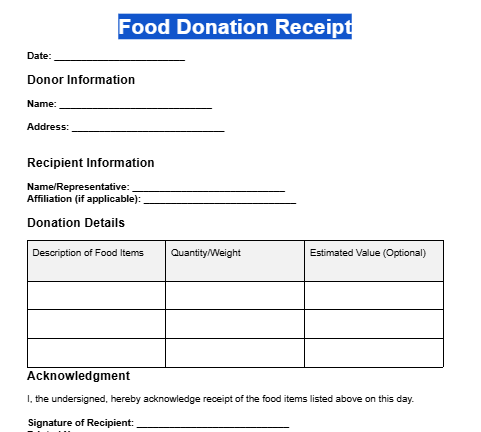
Download Food Donation Receipt to Non-Organization Sample Template
To make documenting your community contributions seamless, we have created a clean, professionally structured template ready for use. It features clear tables for donor and recipient information, an itemized breakdown section, and the necessary acknowledgment areas.
You can access and download the template directly via Google Docs below:
What is Included in a Food Donation Receipt to Non-Organization Sample?
1. Administrative Details
- Receipt Number & Date: Crucial for keeping your personal or business records organized over time.
- Legal Disclaimer Notice: A vital advisory note explicitly clarifying that because the recipient is a non-registered entity, the donation is generally not tax-deductible.
2. Participant Profiles
- Donor Information: Full name, phone number, and email address of the individual or business providing the food.
- Recipient Information: The name of the community group or individual representative, their contact details, and the specific delivery location.
3. Itemized Food Description Table
A clear, scannable table designed to capture the specifics of the contribution:
- Description: Brand names, packaging types (e.g., canned, boxed, fresh), and food types.
- Quantity/Weight: Exact metrics (e.g., “50 cans” or “20 lbs”) to maintain accurate inventory.
- Estimated Value: For the donor’s internal tracking and accounting records only.
4. Acknowledgment & Signatures
- Terms of Agreement: A brief statement confirming that the food items were given freely, in good condition, and without any goods or services exchanged in return.
- Signatures: Dedicated lines for the donor’s signature and the recipient’s Authorized Signature & Stamp to formalize the handover.
FAQs (Frequently Asked Questions)
Can I claim a tax deduction using this receipt?
No. In most jurisdictions, tax deductions for charitable contributions are strictly limited to donations made to officially registered charities or non-profit organizations (such as 501(c)(3) entities in the US). Direct donations to individuals, private groups, or unregistered community initiatives do not qualify for tax write-offs.
Why should I use a receipt if it isn’t tax-deductible?
Documentation is about more than just taxes. Businesses often need receipts to account for inventory adjustments or corporate social responsibility (CSR) tracking. For individuals, it provides peace of mind, establishes trust with grassroots organizers, and ensures clear communication regarding what was delivered.
What types of food are acceptable to list on this receipt?
You can list canned goods, dry shelf-stable foods, fresh produce, or prepared meals, provided they are safe for consumption and comply with local health and safety regulations. Always ensure the items are in good, usable condition before delivery.
Conclusion
Grassroots community work and mutual aid networks are the lifeblood of local neighborhoods. While these initiatives may not always have the formal legal structure of an established charity, using a Food Donation Receipt to Non-Organization brings a helpful layer of professionalism, organization, and transparency to the process.
Also see: 100+ Editable Receipt Templates