
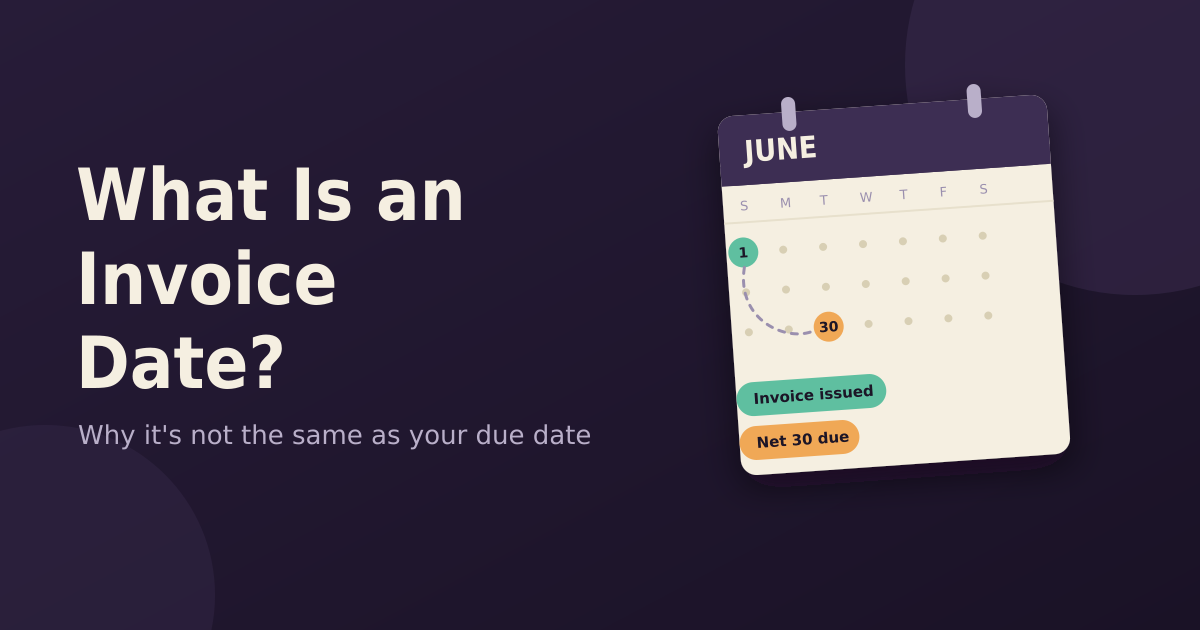
An invoice date is the day a seller officially creates and issues an invoice to a buyer, marking the start of the payment period. It is not the due date, not the delivery date, and not the day you actually get paid — it’s simply the fixed timestamp everything else gets calculated from.
Below is exactly what the invoice date controls, how it differs from the due date and other dates on your invoice, and how to set it correctly so you get paid on time and stay compliant at tax time.
What Is an Invoice Date?
The invoice date is the calendar date printed at the top of an invoice, showing when that invoice was officially created and sent. It’s a fixed, one-time timestamp — once issued, it doesn’t move, even if the client pays early, late, or negotiates new terms afterward.
Think of it as the “clock start” for the entire transaction. Every other timing detail on the invoice, especially the due date, is calculated from this single point.
Invoice Date Format
There is no single invoice date format used worldwide. The appropriate format may depend on the country, business, accounting system, and customer requirements.
Common invoice date formats include:
- September 14, 2026
- Sep 14, 2026
- 09/14/2026
- 2026-09-14
- 14/09/2026
The format 2026-09-14 is particularly clear because it follows the international YYYY-MM-DD format.
When using numerical dates, be careful with formats such as 09/14/2026 and 14/09/2026 because they can be interpreted differently in different countries.
Is Invoice Date and Issue Date the Same?
In most cases, invoice date and issue date mean the same thing. Both terms generally refer to the date an invoice is officially issued to the customer.
For example, if an invoice is issued on September 14, 2026, its invoice date is normally September 14, 2026.
However, specific accounting or tax rules may give these terms more precise meanings. Businesses should follow the requirements that apply to their jurisdiction and type of transaction.
Invoice Date vs. Purchase Date
The invoice date is the date the invoice is issued, while the purchase date is generally the date the customer buys or receives the goods or services.
These dates can be the same, but they do not have to be.
For example, a customer could purchase goods on September 10, while the seller issues the invoice on September 12.
In that situation:
Purchase date: September 10, 2026
Invoice date: September 12, 2026
This distinction can matter for accounting, tax reporting, inventory records, and payment tracking.
Invoice Date vs. Due Date
The invoice date tells you when the invoice was issued. The due date tells you when payment is expected.
For example:
Invoice date: September 14, 2026
Payment terms: Net 30
Due date: October 14, 2026
The due date is usually determined by the payment terms stated on the invoice.
Some invoices may be due immediately, while others may allow 7, 15, 30, 60, or more days for payment.
Frequently Asked Questions
Is purchase date the same as invoice date?
No. The purchase date is when the customer makes the purchase, while the invoice date is when the seller issues the invoice. They can be the same date, but they can also be different.
How do I find the invoice date?
Look near the top of the invoice for a label such as Invoice Date, Issue Date, Date Issued, or Date. It is commonly displayed near the invoice number and due date.
What is the difference between the invoice date and the due date?
The invoice date is when the invoice is issued, while the due date is when payment is expected. For example, an invoice issued on September 14 with Net 30 terms may have a due date of October 14.
Is the invoice date the same as the issue date?
Usually, yes. Invoice date and issue date generally refer to the date an invoice is officially issued to the customer.
Is invoice date the same as order date?
No. The order date is when the customer places an order, while the invoice date is when the seller issues the invoice. The two dates may be the same or different.
Can the invoice date and purchase date be different?
Yes. A customer may purchase goods or services on one date and receive the invoice on another date.
Does the invoice date determine the payment due date?
It often does, but this depends on the payment terms. For example, an invoice with Net 30 terms may be due 30 days after the invoice date.
Read: What Is an Invoice Number?
Final Thoughts
The invoice date is the date an invoice is officially issued. It is an important reference for tracking invoices, calculating payment deadlines, organizing financial records, and communicating with customers.
The invoice date should not automatically be confused with the purchase date, order date, or due date. Keeping these dates clearly separated helps businesses maintain accurate and professional invoicing records.
Also see: