
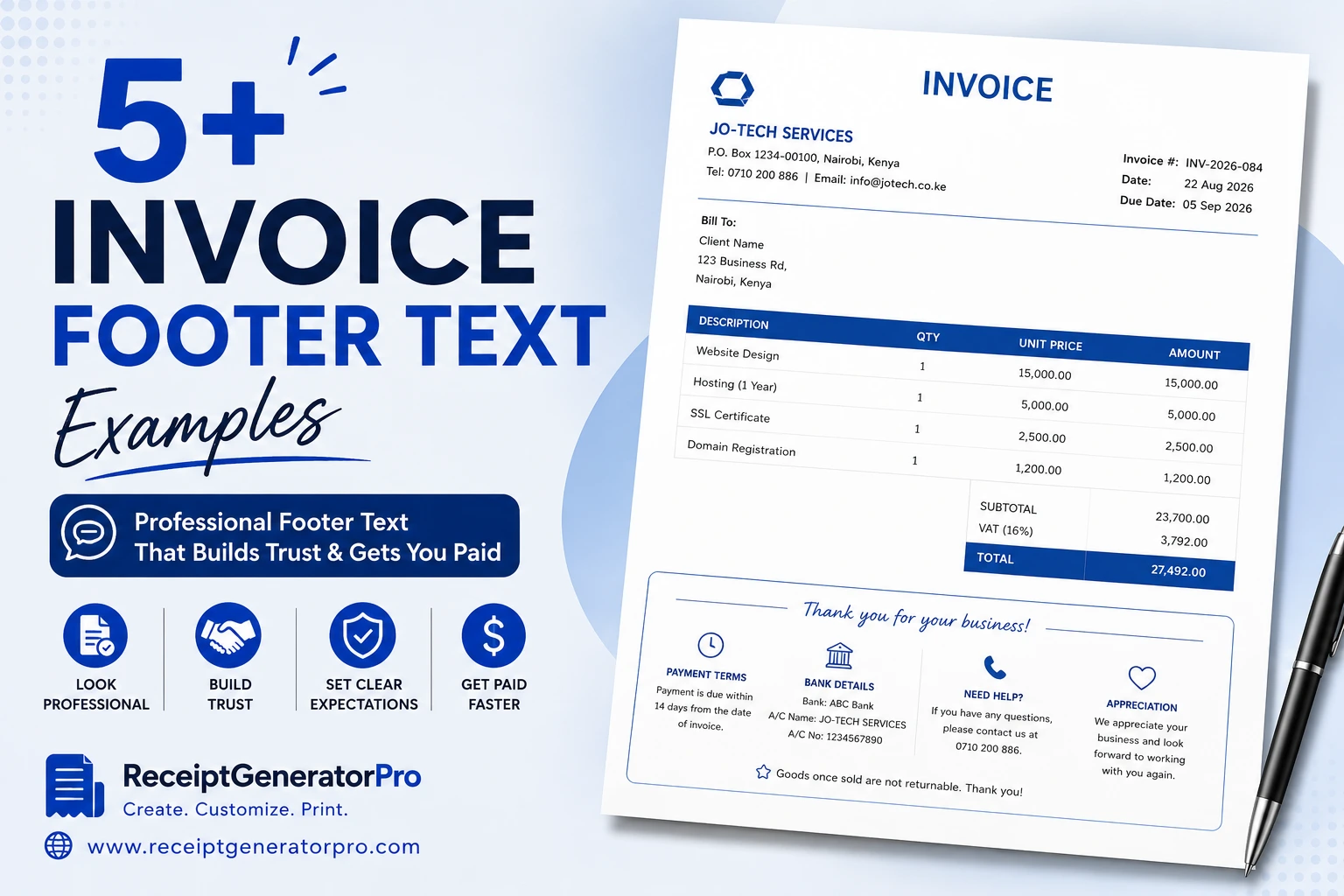
Looking for the best invoice footer text examples? You’re in the right place.
An invoice footer is the block of text at the bottom of an invoice that covers payment terms, legal disclaimers, thank-you notes, and contact details. It’s the last thing a client reads before they pay, which makes it one of the most overlooked but highest-impact parts of your invoice.
Below you’ll find footer text examples organized by purpose, plus guidance on what’s legally smart to include and what to leave out.
What Is an Invoice Footer, Exactly?
The footer sits below the line items and total on an invoice. According to Stripe’s guide on creating an invoice, this is the place to include legal details, policies, or other relevant terms — such as a refund or return policy — along with a short thank-you message and a note on how customers can reach you with questions.
Think of it as the fine print plus the goodwill message, combined in two or three lines.
What to Include in an Invoice Footer
Not every invoice needs every element below. Pick what applies to your business and keep the total footer under 3–4 short lines.
- Payment terms — due date, accepted methods, late fee policy
- Bank or payment details — account number, routing number, or payment link
- Legal or tax disclaimers — tax-exempt status, VAT notes, “no signature required”
- Return or refund policy — especially for product-based businesses
- Thank-you message — a short line of goodwill
- Contact information — who to reach with billing questions
Invoice Footer Text Examples by Category
Payment Terms and Due Date
- “Payment is due within 30 days of the invoice date. A 1.5% monthly interest charge applies to overdue balances.”
- “Net 15 terms apply. Please remit payment by the due date shown above.”
- “Payment due upon receipt. We accept ACH, credit card, and check.”
- “Thank you for your prompt payment within 14 days of invoice receipt.”
Late Fees and Interest
- “Invoices unpaid after 30 days are subject to a 2% monthly late fee.”
- “A late payment fee of $25 will be applied to any balance outstanding after the due date.”
- “Interest of 1.5% per month will accrue on all past-due balances.”
Bank and Payment Details
- “Please make checks payable to [Business Name]. For wire transfers: Bank Name, Account #, Routing #.”
- “Pay online at [payment link]. Reference invoice number [XXX] with your payment.”
- “Venmo/Zelle: [handle]. Please include your invoice number in the note.”
Legal and Tax Disclaimers
- “This invoice does not include sales tax; buyer is responsible for reporting use tax where applicable.”
- “This is a computer-generated invoice and does not require a signature.”
- “Tax ID / EIN: XX-XXXXXXX”
- “Prices shown are exempt from sales tax under [state] reseller certificate #XXXXX.”
Return and Refund Policy
- “All sales are final unless otherwise agreed in writing.”
- “Returns accepted within 14 days of delivery with original receipt.”
- “Refunds are issued to the original payment method within 5–7 business days.”
Thank-You and Relationship Messages
- “Thank you for your business — we appreciate the opportunity to work with you.”
- “We value your continued partnership and look forward to working together again.”
- “Questions about this invoice? Reach us at [email/phone] — we’re happy to help.”
Combined / All-in-One Footer
“Payment due within 30 days. Late payments incur a 1.5% monthly fee. Make checks payable to [Business Name] or pay online at [link]. Thank you for your business — questions? Contact us at [email/phone].”
How to Write Your Own Invoice Footer in 3 Steps
1. State the payment terms first. Due date and accepted payment methods should always come before any goodwill message — this is the part clients actually act on.
2. Add only the legal language you need. Don’t pad the footer with boilerplate that doesn’t apply to your business — a tax-exempt note only belongs there if you’re actually tax-exempt.
3. Close with a short thank-you and contact line. One sentence is enough. It keeps the tone professional without turning the footer into a wall of text.
Frequently Asked Questions
What should an invoice footer include?
Payment terms, accepted payment methods, any late fee policy, relevant legal or tax disclaimers, and a short thank-you or contact line.
Is a thank-you message necessary on an invoice?
No, but a short thank-you message such as “Thanks for your business” can leave a good impression and costs nothing to add.
Can I add a late fee to an invoice footer after the client already owes money?
No — late fee terms need to appear on the invoice before or at the time it’s issued to be enforceable. Adding them retroactively won’t hold up if disputed.
Do I need to include tax information in the footer?
Only if it applies to your situation — for example, a tax-exempt note or your EIN. U.S. invoices aren’t held to the same strict tax-invoice rules as some other countries, but clear documentation still protects you with both customers and the IRS.
Build Your Invoice Footer in Minutes
Rather than formatting footer text by hand every time, use a ready-made invoice template that already has a footer section built in. Try our free invoice generator to create a polished, professional invoice — payment terms, footer notes, and all — in just a few minutes.
Also see: Receipt Header Template Word