
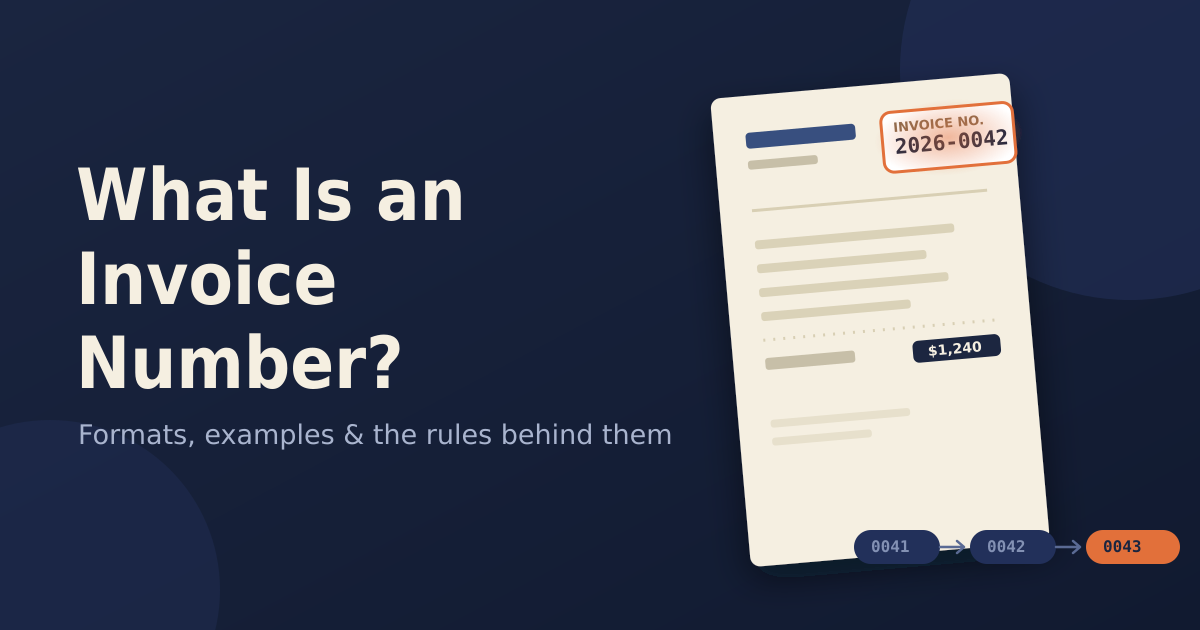
An invoice number is the identifier printed at the top of an invoice, usually right next to the invoice date. It functions like a receipt number or order number: a single reference point that lets you, your client, and your accountant all point to the same document without confusion.
Think of it as the invoice’s fingerprint. Once assigned, that number should never be reused, altered, or applied to a different invoice, even if the original is canceled.
Also see: Invoice Date: A Complete Guide
Why Invoice Numbers Matter
An invoice number isn’t just an administrative formality — it protects your business in three concrete ways.
Payment tracking. When a client emails asking about “that invoice from last month,” a number lets you pull up the exact record in seconds instead of scrolling through a list of amounts and dates.
Audit readiness. Tax authorities expect a continuous, gap-free record of invoices. A missing or duplicated invoice number is one of the first red flags that can trigger closer scrutiny during a tax review.
Professional credibility. A clean, consistent numbering system signals that a business has its finances under control, which matters to clients evaluating whether to work with you again.
Is an Invoice Number Legally Required?
Yes, in most jurisdictions, though the exact rules vary by country. In the UK and across the European Union, invoice numbers must be unique and follow a sequential order under VAT law. In the US, Canada, and Australia, invoice numbers must be unique, and while strict sequential numbering isn’t always mandated by federal law, tax authorities strongly recommend it as the clearest way to demonstrate complete, unaltered financial records.
Gaps in a sequence aren’t automatically illegal — a canceled invoice or a skipped number can usually be explained — but you should be able to account for any break if asked. What you can never do is reuse a number or assign the same number to two different invoices.
6 Common Invoice Numbering Formats
There’s no single required format. What matters legally is uniqueness and consistency; the structure you choose depends on your business size and how you want to sort records later.
1. Simple sequential Format: 1001, 1002, 1003 Best for solo freelancers and very small businesses issuing a low volume of invoices. It’s the easiest system to set up and the hardest to get wrong.
2. Year-prefixed sequential Format: 2026-0001, 2026-0002 Resets each January and separates tax years cleanly, which makes year-end bookkeeping simpler. This is the format most small businesses and agencies settle on as they grow.
3. Year-month sequential Format: 2026-03-001, 2026-03-002 Useful for businesses issuing a high volume of invoices — 200 or more a month — since it keeps each month’s records grouped and easy to scan.
4. Date-based Format: 20260315-001 Combines the exact invoice date with a daily counter, which is helpful for businesses that issue several invoices on the same day and want the date visible without opening the document.
5. Client-coded Format: ACME-001, BLOOM-002 Adds a client abbreviation before the sequence number, which helps agencies and consultants sort invoices by account rather than by date.
6. Project-coded Format: PRJ204-01 Ties the invoice to a specific project or job number, common in construction, freelance, and contract work where multiple invoices get billed against one larger project.
Invoice Numbering Best Practices
A few habits keep your numbering system audit-proof and easy to manage as your business grows.
- Never reuse a number, even for a canceled or voided invoice. Void it in your records and move on to the next number in sequence.
- Don’t start at 1. Starting at 1001 or using a year prefix looks more established and avoids signaling to a new client that they’re your very first sale.
- Use letters only as prefixes, not within the numeric sequence itself. Mixing letters into the counting portion makes sorting and data entry harder.
- Pad your numbers with leading zeros (0001 instead of 1) so your invoice list sorts correctly once you pass number 9.
- Keep one sequence per business entity. If you run multiple businesses or brands, give each its own numbering system rather than sharing one counter.
- Automate it. Most accounting and invoicing software will auto-increment invoice numbers for you, which removes the risk of manual duplication entirely.
What Else Belongs Next to the Invoice Number
The invoice number works alongside a few other required fields to make an invoice complete and legally valid:
- Invoice date (when it was issued)
- Due date (when payment is expected)
- Your business name and contact information
- The client’s name and billing information
- An itemized list of goods or services with amounts
- Total amount due and accepted payment methods
Frequently Asked Questions
Where Can I Find Invoice Number?
An invoice number is usually printed at the top of the invoice, near the invoice date, labeled “Invoice #” or “Invoice No.” In digital invoices or emails, it also often appears in the subject line or the invoice details section.
What happens if I skip an invoice number by mistake?
A gap in your sequence isn’t automatically a problem, but you should be able to explain it if a client or tax authority asks — for example, a voided invoice or a corrected duplicate entry. Never reuse the skipped number; just continue forward from where you left off.
Do invoice numbers need to include the date?
No, but date-based or year-prefixed formats make chronological sorting easier, especially at tax time. It’s a convenience feature, not a legal requirement.
Can two different clients have invoices with the same number?
No. Every invoice number your business issues must be unique across your entire business, not just unique per client.
Does invoicing software generate invoice numbers automatically?
Yes. Most invoicing and accounting platforms auto-increment the next number in your sequence by default, which is the simplest way to avoid duplicate or skipped numbers as your invoice volume grows.