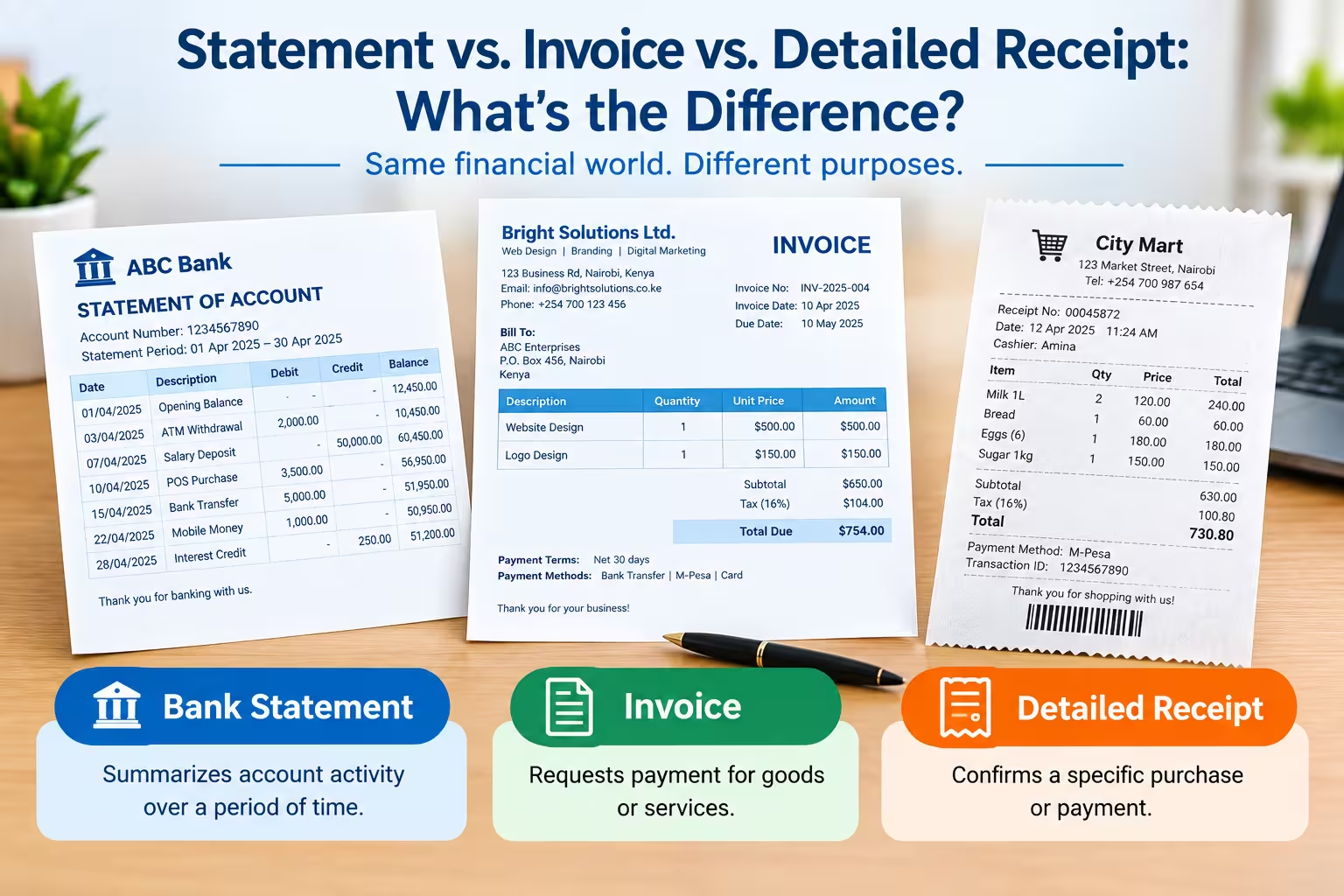
A statement, an invoice, and a receipt are three different billing documents that get confused constantly. An invoice requests payment for specific goods or services and includes an amount due. A statement summarizes account activity — including multiple invoices and payments — over a set period, usually without asking for new payment. A receipt confirms that payment was already received. If you send the wrong one, customers can end up double-paying, disputing charges, or ignoring bills they were legally owed.
Below, we break down each document, show you exactly what belongs on it, and give you copy-ready templates for all three.
What Is an Invoice?
An invoice is a request for payment. A business sends it to a customer after delivering goods or services, and it lists exactly what was provided, at what cost, and by when payment is due.
Unlike a statement, an invoice covers one transaction (or one billing cycle of work) and creates a legal payment obligation. On the buyer’s side, receiving an invoice is what triggers an accounts payable entry — the buyer now owes money and has to record that liability, a distinction laid out clearly in AccountingTools’ breakdown of invoices versus statements.
What an invoice must include
- Invoice number (unique, sequential)
- Business name, address, and contact information
- Customer name and billing address
- Invoice date and payment due date
- Itemized list of products/services, quantities, and unit prices
- Subtotal, taxes, discounts, and total amount due
- Accepted payment methods and terms (e.g., “Net 30”)
Invoice template
INVOICE
Invoice #: INV-1042              Date: 09/15/2026
From: [Your Business Name, Address, Phone, Email]
Bill To: [Customer Name, Address]

Due Date: 10/15/2026 (Net 30)

Description                Qty      Rate       Amount
------------------------------------------------------
Website design services      1     $1,200      $1,200.00
Hosting setup                1       $150         $150.00
------------------------------------------------------
                                   Subtotal:   $1,350.00
                                   Tax (7%):      $94.50
                                   TOTAL DUE:  $1,444.50

Payment terms: Due within 30 days. Late payments subject to 1.5% monthly fee.
Payment methods: Bank transfer, credit card, check
What Is a Statement?
A statement — sometimes called a “statement of account” or “billing statement” — is a periodic summary of everything that happened on a customer’s account over a set timeframe, typically a month. It lists the starting balance, every invoice issued, every payment received, any credits or adjustments, and the ending balance.
The key thing a statement is not: a new bill. According to Helcim’s guide to invoices, receipts, and statements, a statement typically does not spell out a fresh amount due the way an invoice does — it’s informational, helping the customer reconcile what they’ve already been billed against what they’ve paid. It’s most useful for accounts with recurring or multiple transactions, like a client who’s billed weekly or a vendor account with several open invoices.
What a statement must include
- Statement period (e.g., “September 1–30, 2026”)
- Beginning balance
- List of invoices issued during the period (with dates and amounts)
- Payments and credits received during the period
- Ending balance / total outstanding
- Aging summary (current, 30/60/90 days past due), if applicable
Statement template
STATEMENT OF ACCOUNT
Account: [Customer Name]              Statement Period: 09/01/2026–09/30/2026
Statement Date: 09/30/2026

Beginning Balance (as of 09/01/2026):        $2,100.00

Date        Description                Amount
-----------------------------------------------
09/05/2026  Invoice #INV-1039          +$800.00
09/12/2026  Payment received           -$1,200.00
09/20/2026  Invoice #INV-1042          +$1,444.50
-----------------------------------------------
Ending Balance (as of 09/30/2026):           $3,144.50

Aging: Current $1,444.50 | 30 days $800.00 | 60+ days $900.00
Please remit payment for all invoices marked past due.
What Is a Detailed Receipt?
A receipt is proof that payment was already made. It’s issued after the money changes hands, not before, which is the opposite timing of an invoice.
A “detailed” or “itemized” receipt goes further than a basic proof-of-purchase slip — it breaks down each item or service, not just the total charged. This distinction matters for tax purposes: QuickBooks’ explainer on invoices, sales receipts, bills, and statements notes that a sales receipt records a purchase paid for immediately, while the IRS generally expects itemized documentation — not just a total — for deductible business expenses of $75 or more, per the substantiation rules in IRS Publication 463.
What a detailed receipt must include
- Business name and contact information
- Receipt number and date of transaction
- Itemized list of goods/services purchased, with individual prices
- Subtotal, tax, tip (if applicable), and total paid
- Payment method (cash, card ending in ####, etc.)
- Confirmation the balance is $0 / paid in full
Detailed receipt template
RECEIPT
Receipt #: RCT-5521                Date: 09/15/2026
From: [Your Business Name]
Paid By: [Customer Name]

Item                        Qty      Price       Amount
---------------------------------------------------------
Consultation (1 hr)           1     $150.00      $150.00
Follow-up materials           1      $25.00       $25.00
---------------------------------------------------------
                                    Subtotal:    $175.00
                                    Tax (7%):     $12.25
                                    TOTAL PAID:  $187.25

Payment Method: Visa ending in 4417
Balance Due: $0.00 — Paid in Full| Invoice | Statement | Detailed Receipt | |
|---|---|---|---|
| Purpose | Requests payment | Summarizes account activity | Confirms payment received |
| Timing | Sent before payment | Sent periodically (monthly, etc.) | Sent after payment |
| Covers | One transaction/order | Multiple transactions over a period | One completed payment |
| Includes new amount due? | Yes | Usually not (recap only) | No — balance is $0 |
| Triggers an accounting entry? | Yes, for the buyer (accounts payable) | No — informational only | Yes, closes out the receivable |
| Legal weight | Payment obligation | Informational reminder | Proof of purchase/payment |
When to Use Each Document
Use an invoice when you’ve completed a job or shipped an order and need to get paid for that specific transaction.
Use a statement when a customer has multiple open invoices or recurring charges and needs one consolidated view of what they’ve been billed and what they still owe — this is standard practice for vendor accounts, subscription billing, and B2B relationships with ongoing work.
Use a detailed receipt the moment a payment is finalized, whether that’s a point-of-sale purchase or the final payment on an invoice. Customers need it for expense reports, returns, and tax deductions; you need it as your own transaction record.
Related Articles:
Bank Statement vs Bank Receipt: What’s the Difference?
Importance of Keeping Receipts: 10 Reasons You Should Save Them