
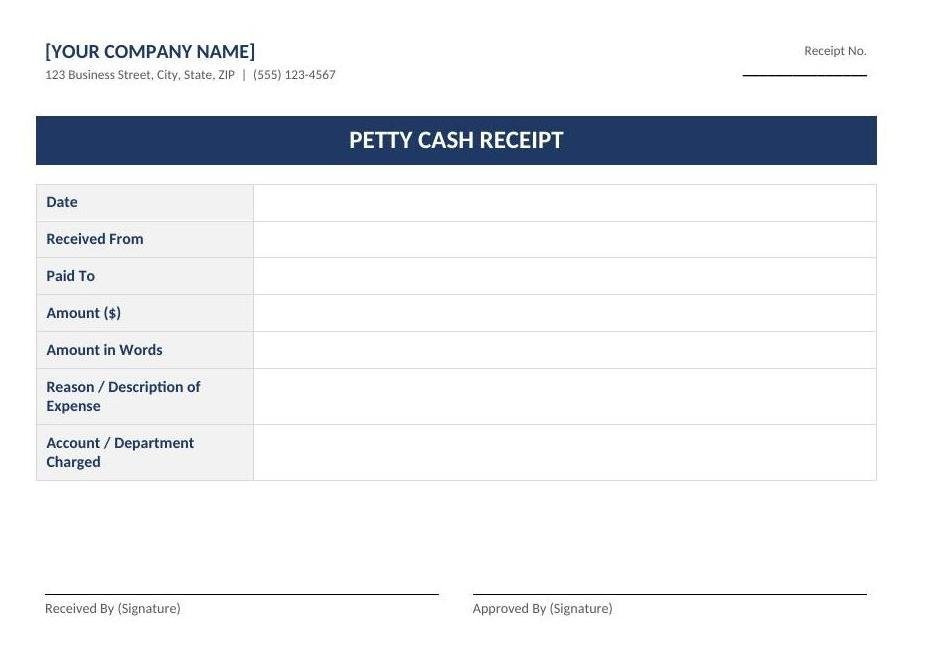
A petty cash receipt template is a pre-formatted form that records small cash payments made from an office’s petty cash fund. It captures the date, amount, recipient, and reason for the payment so every dollar can be tracked and matched to the petty cash log later.
Below you’ll find a free, editable petty cash receipt sample template in Word format, a filled-out sample for reference, and a clear explanation of what to include so your records hold up during an audit or month-end reconciliation.

Download Petty Cash Receipt Sample Templates
The templates below includes two ready-to-print receipts per page, so you can cut them apart and use them individually. They are built in Microsoft Word (.docx), fully editable, and formatted to print cleanly on standard US Letter paper.
Petty Cash Receipt Sample
What Should a Petty Cash Receipt Include?
A complete petty cash receipt should always capture these fields:
- Date – when the cash was disbursed
- Receipt number – a sequential number for tracking and audit trails
- Received from / Paid to – the name of the employee or vendor
- Amount – the dollar figure, written in numerals and in words to prevent alteration
- Reason for the expense – a short description of what the cash was used for
- Account or department charged – so the expense lands in the correct budget line
- Signatures – the person receiving the cash and the person approving it
Leaving out any of these fields is the most common reason petty cash records get rejected during an internal audit.
How to Fill Out a Petty Cash Receipt
- Write the date and assign the next receipt number from your log before handing over any cash.
- Record who is receiving the money and, if it’s a reimbursement, what they already purchased.
- Enter the exact amount in both numerals and words to prevent anyone from altering the figure later.
- Describe the expense specifically — “office supplies” is fine, but “printer paper” is better for expense tracking.
- Get two signatures: the person receiving the cash and the custodian or manager approving the disbursement.
- File the receipt immediately with your petty cash log or voucher book, not loose in a drawer.
Frequently Asked Questions
Do I need a receipt for every petty cash transaction?
Yes. Even small amounts under $5 should have a signed receipt, since the total of many small, undocumented payments adds up and creates a gap in the petty cash log.
Can I use a digital petty cash receipt instead of paper?
Yes. Many businesses now fill out the same template in a shared spreadsheet or a scanned PDF signed electronically, as long as it captures the same required fields and is stored consistently.
What’s the difference between a petty cash receipt and a regular expense receipt?
A petty cash receipt documents money leaving an internal cash fund and is created by the business itself. A regular expense receipt (like a store receipt) is issued by the vendor and gets attached to the petty cash receipt as backup.
How long should petty cash receipts be kept?
Most businesses retain them for at least three years to align with standard tax and audit record-keeping requirements, though local regulations may require longer.
Download the Template and Get Started
Tracking petty cash doesn’t need to be complicated — it just needs to be consistent. Download the free Word template above, print a stack of receipts, and start numbering them from your next disbursement.
Explore More Templates
Need a different style or a more specialized layout? Explore more 100+ editable receipt templates to find the perfect format for your business needs.